
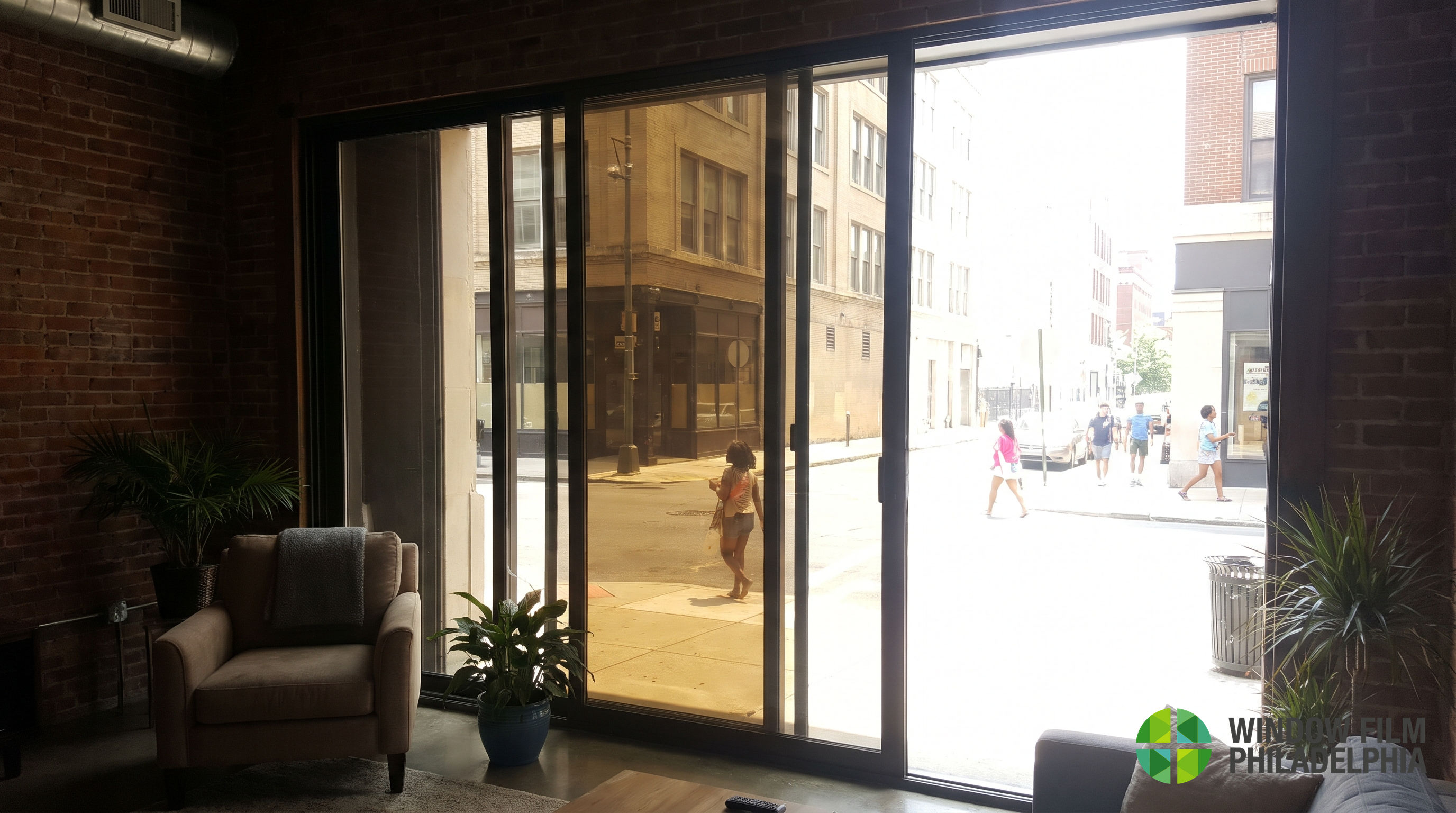
The question comes up on almost every summer walkthrough: does tinting windows reduce heat, or is it mostly a cosmetic upgrade? A property manager in a glass-heavy Center City tower asks it while standing in a west-facing conference room that hits 84 degrees by 3 p.m. A homeowner in a South Philly rowhome asks it in a second-floor bedroom where the afternoon sun turns the space into a greenhouse. The answer, backed by our own install data and manufacturer testing, is yes — quality window film rejects a measurable share of solar heat, and in Philadelphia’s humid July heat waves, that difference shows up on the thermostat.
The honest answer depends on the glass, the exposure, and the film construction — but the numbers behind the answer are far more concrete than most marketing claims. Here is how much heat film actually blocks, which technologies matter, and where the results show up on Philadelphia rowhomes, storefronts, and office towers.
How Window Film Actually Blocks Solar Heat
Sunlight hitting your glass carries energy in three forms: visible light, infrared radiation (which you feel as heat), and ultraviolet radiation. Standard clear glass lets nearly all of it through. Window film is a micro-thin polyester or ceramic laminate applied to the interior surface of the glass, and it is engineered to reflect or absorb a portion of that energy before it ever enters the room.
The numbers that matter are TSER (Total Solar Energy Rejected) and SHGC (Solar Heat Gain Coefficient). A high-performance ceramic film like 3M Prestige Series can reject up to 97% of infrared heat and roughly 60% of total solar energy while still letting in 70% or more of visible light. LLumar’s ceramic lines and Vista’s solar control films perform in similar ranges with different tint profiles. These are laboratory-tested figures, but in our experience the field results track closely — a room that used to spike in the afternoon simply doesn’t anymore.
It is worth separating heat rejection from UV rejection. Nearly every quality film blocks 99% of UV, which protects floors, furnishings, and skin. UV contributes relatively little to the sensation of heat, though — infrared and visible light carry most of the thermal load. So a film’s TSER rating, not just its UV number, is what tells you whether a room will actually feel cooler.
Does Tinting Windows Reduce Heat Enough to Lower Cooling Costs?
For the direct question — does tinting windows reduce heat enough to matter on a utility bill — the honest answer is that it depends on your glass exposure, but the physics are not in dispute. Solar gain through untreated windows can account for a large share of a building’s cooling load in summer, especially on west and south orientations. Cutting that gain at the glass means your AC cycles less often and runs shorter.
We see the clearest results in buildings with large glass areas: Center City offices with curtain-wall facades, retail storefronts in Old City, and sunrooms or top-floor bedrooms in Queen Village and Fairmount rowhomes. In those spaces, occupants routinely report rooms that previously became unusable in the afternoon are comfortable all day, and thermostats set at the same temperature simply cycle less. For a deeper independent explanation of solar heat gain and glazing performance, the U.S. Department of Energy’s building enclosures research on how windows affect energy use covers how films, coatings, and glazing choices reduce solar gain.
What film will not do is replace insulation or fix a poorly sealed envelope. If a building loses cool air through leaky ductwork or an uninsulated roof, film helps at the glass but can’t carry the whole load. We always tell clients to think of film as one strong layer in a broader efficiency strategy, not a silver bullet.
Where Philadelphia Buildings Gain the Most From Heat-Rejecting Film
Not every window deserves film first. When we survey a property, we prioritize by orientation and use:
- West-facing glass. The brutal afternoon sun through a west exposure is the single biggest heat problem in most Philadelphia buildings. A Rittenhouse office with a full west wall or a Manayunk rowhome whose back windows face the evening sun benefits most.
- South-facing glass. High sun angles year-round make south windows a steady heat contributor from late spring through early fall.
- Large single-pane glass. Many Society Hill brownstones and Old City storefronts still have original single-pane windows. These transfer heat aggressively, and solar control film delivers an immediate improvement without altering historic appearance.
- Skylights and sunrooms. Horizontal and near-horizontal glazing takes direct sun all day. Ceramic films designed for these applications make enclosed porches usable in August instead of unbearable.
North-facing windows with heavy shade often need nothing at all. Applying film everywhere just to be thorough wastes budget that could go toward the exposures that actually overheat.
The Film Technologies We Recommend for Heat Control
Not all films reject heat equally, and the difference comes down to construction:
- Multilayer optical film (3M Prestige). Dozens of micro-layers that reject infrared while staying optically clear. Our go-to for historic facades and storefronts where dark tint is not acceptable.
- Ceramic films (LLumar, 3M Ceramic). Non-metallic, non-reflective, high IR rejection, and signal-safe for wifi and cell devices. Excellent for offices full of electronics.
- Spectrally selective dyed/metallized hybrids (Vista). A strong balance of heat rejection, glare control, and value for residential budgets.
- Low-E window film. A newer category that helps in winter too — it reflects interior heat back into the room, reducing heat loss through glass during Philadelphia’s cold months. We recommend it for year-round comfort on big glass walls.
What we avoid recommending is cheap dyed film sold purely on darkness. A dark dyed film absorbs heat into the glass itself, which can stress sealed insulated glass units and still passes plenty of infrared. Performance ratings, not darkness, are what cool a room.
Real Results From Local Installations
A Fishtown client with a third-floor bedroom under a flat roof called us every summer about a room that hit uncomfortable temperatures by noon. We installed a ceramic film with roughly 80% total solar energy rejection on the two worst exposures. The following August, the room stayed usable all day with the same window AC unit that previously ran constantly.
On the commercial side, a Navy Yard office suite with floor-to-ceiling west glass cut its afternoon glare complaints to near zero after we applied a spectrally selective film, and the tenant reported less AC runtime on peak days. Historic commissions and landlords in Old City often prefer these near-invisible films precisely because they deliver heat control without changing a building’s street-facing character.
Installation Done Right Matters As Much As the Film
Even the best film underperforms if it is installed badly. Our process is deliberate: glass is cleaned and scraped of paint and debris, edges are cut precisely, and film is applied with a slip solution and squeegeed to remove every void. What we never do is apply film to wet or contaminated glass — trapped moisture and dust create hazy, visible defects within a week. On insulated glass units, we check manufacturer-approved film-to-glass compatibility, because the wrong absorptive film on the wrong glass can risk thermal stress cracks.
Curing takes time, too. Films need up to 30 days in humid summer air to fully dry and reach optical clarity. We set that expectation up front so a slightly wavy appearance in week one doesn’t cause concern.
What Heat-Rejecting Film Does Not Do
Being straight with clients builds trust, so here is the honest list of limits: film does not insulate like double glazing, it does not stop drafts, and it does not eliminate the need for shading on extreme exposures. It also does not make a poorly sized HVAC system adequate. If a room overheats because of a roof without ventilation, film will help at the glass but the root cause remains. We would rather sell you the right solution than the biggest one.
Frequently Asked Questions
How much heat does window film actually block?
High-performance ceramic and multilayer films reject 60% to over 80% of total solar energy (TSER), with infrared rejection often above 90%. The exact figure depends on the film and the glass type, and we quote tested ratings for every product we install rather than vague claims.
Will film make my rooms darker?
Not necessarily. Spectrally selective and ceramic films can reject a majority of heat while transmitting 60–70% of visible light, which most people cannot distinguish from untreated glass. Darker films are only necessary when glare control is the priority.
Does film help in winter, or only summer?
Standard solar films are primarily summer products, but low-E window film reflects interior radiant heat back into the room, reducing winter heat loss through glass. For buildings with large glass areas we often specify low-E films for year-round benefit.
How long does window film last?
Quality films from 3M, LLumar, and Vista are engineered for decades of service, and manufacturer warranty coverage varies by film line and application — we spell out the exact terms for your specific glass and film choice during the quote.
Can film be removed if we change the glass or move out?
Yes. Film is applied as a removable laminate and can be stripped with heat and solvents without damaging the glass, which makes it attractive for tenants and historic properties where permanent glazing changes are not allowed.
Is window film better than blinds or curtains for heat?
They solve different problems. Interior shading blocks light after heat has already entered the room through the glass; film rejects solar energy at the glass itself before it becomes room heat. Many clients combine both — film for heat and UV, blinds for privacy and light control.
Get a Free Heat Assessment for Your Philadelphia Property
We have spent years measuring sun exposure on Philadelphia rowhomes, storefronts, and towers, and we would rather show you the numbers than sell you a roll of film. If a room in your home or office overheats every afternoon, reach out through our contact page to schedule a free on-site assessment — we will map your hot exposures, quote tested film performance, and give you a straightforward recommendation.