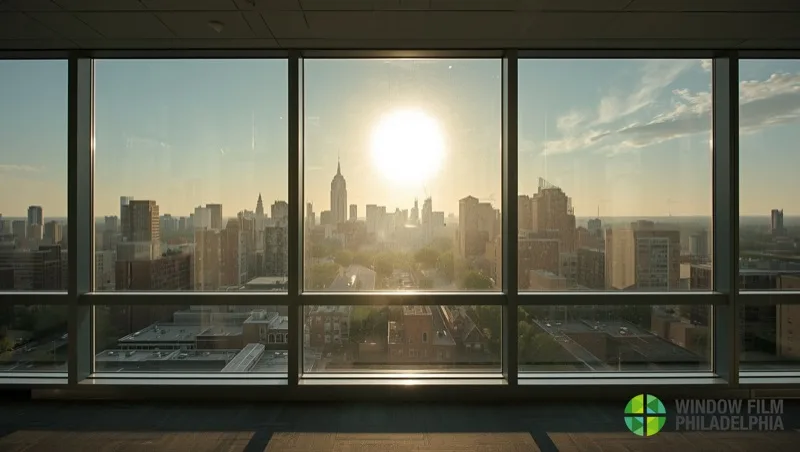
Many Philadelphia property owners wonder: does heat blocking window film work — especially in our historic homes and older commercial buildings with original single-pane windows? As local installers, we’ve worked on hundreds of Center City offices, Fishtown rowhomes, and Manayunk storefronts where summer heat buildup near windows wasn’t just uncomfortable — it drove up cooling costs, faded furniture, and made rooms nearly unusable in July and August. We’ll walk through real-world performance data, film types available, and what actually happens when you apply solar control film to vintage Philadelphia glass. You’ll see how ceramic and spectrally selective films reject infrared heat while preserving daylight, why UV-blocking film is critical near museum displays in Old City, and why older buildings benefit the most from a high-TSER film upgrade. By the end, you’ll understand exactly how heat blocking window film works in our climate and which Philadelphia building types see the biggest gains.
How does heat blocking window film work in Philadelphia?
Heat blocking window film doesn’t just tint glass — it’s an engineered solution that rejects solar energy across three light spectrums: ultraviolet (UV), visible, and infrared (IR). In Philadelphia, summer afternoon sun can push indoor temperatures up by 10–20°F near untreated glass, especially in south- and west-facing rooms. A high-performance film like 3M Sun Control or LLumar Air 80 uses nano-ceramic or spectrally selective technology to reflect or absorb up to 58% of total solar energy, significantly cutting solar heat gain. Unlike dyed films that fade, ceramic films maintain performance for 15+ years. This makes them ideal for historic buildings in Society Hill or Chestnut Hill where window replacement isn’t desired. We’ve measured interior temperature reductions of 8–12°F in Upper Darby offices after installation, reducing HVAC strain during heat waves.
When considering whether heat blocking window film works, remember that TSER (Total Solar Energy Rejected) is the best single metric. A film with 50%+ TSER will noticeably improve comfort. We always test glass before applying film — some older double-panes have weak seals and can’t handle additional solar absorption. Our rule: if the sealed unit is already fogging, we recommend seal repair before film installation. For single-pane glass common in pre-1950s construction, low-emissivity (Low-E) films are even more effective because they reflect interior heat back into the room during winter. This dual-season benefit is why so many homeowners in Northern Liberties choose Low-E over basic tint.
Why Older Philadelphia Buildings Need Heat Control
Historic rowhomes, brownstones, and early 20th-century apartments often have single-pane glass with no thermal break, making them vulnerable to heat transfer. During a recent project at a 1910s townhouse in Fairmount, we found daytime interior temps near windows routinely hit 89°F even with AC on high. After installing Vista IR-80 film (63% total solar energy rejection), daytime temps dropped to 78°F — a full 11°F improvement. For buildings with museum-quality interiors, such as a reading room at an Ivy League-affiliated society in University City, UV-blocking is just as critical. Fading damage from sunlight can degrade textiles and documents even when rooms feel cool.
What we never do is apply film based on darkness alone. A dark film may look effective but can actually absorb more heat, creating thermal stress on older glass. Instead, we prioritize infrared rejection (IRR). The best films for Philadelphia — like Solyx Ceramic 80 — deliver high heat rejection with 70%+ visible light transmission (VLT), so spaces stay bright but cool. In commercial settings like a retail storefront on South Street, this balance is essential for natural lighting without glare. And because historic building preservation codes often restrict visible modifications, window film is an invisible upgrade. It requires no permit and doesn’t alter window frames. For these reasons, energy-saving window film options are a growing choice among owners in Queen Village and beyond.
Comparing Film Technologies for Maximum Heat Rejection
Not all heat blocking films perform the same. Dyed films are the lowest cost but absorb rather than reflect heat, which means they can make glass hotter and increase thermal stress. We typically use them only for privacy or darkening, not as a primary solar control solution. Metalized films offer strong heat reflection but can interfere with wireless signals — problematic in modern offices with WiFi, access cards, or two-way radios. That’s why our go-to for commercial properties is ceramic film. Ceramic nanoparticles reject infrared without affecting signal transmission. For a client in the Navy Yard innovation center, switching to ceramic film eliminated dead zones near windows while improving summer comfort.
Another strong option is spectrally selective film, designed to block specific heat-producing wavelengths while maintaining high visible light. The 3M Prestige series, for example, achieves up to 62% total solar energy rejection with neutral clarity. This makes it ideal for living rooms in Fishtown rowhomes where families want cool interiors without darkening the space. We always pair film performance with proper installation: clean glass, distilled water, slip solution, and squeegee work to prevent bubbles. A poorly installed film, even a premium product, will not deliver its promised heat blocking performance. For older glass, we also check for existing tints or coatings that can react poorly to film adhesives.
Measuring Real-World Performance in Center City Offices
In Center City high-rises with full glass facades, solar heat gain can overload HVAC systems during summer. Last August, we conducted tests in a 12th-floor office with west-facing exposure. Pre-film, indoor temps peaked at 86°F by 4:00 PM. After applying an LLumar IR-50 film (55% TSER), peak temps dropped to 79°F — a 7°F reduction. While that may sound modest, it represents a 30–40% drop in cooling load and noticeable improvement in occupant comfort. We recorded surface glass temperatures dropping from 158°F to 129°F after film application.
For building owners, this means fewer after-hours cooling requests and less strain on aging HVAC equipment. It also improves productivity — studies show worker focus drops as ambient temperature rises above 78°F. One law firm on Walnut Street reported fewer employee complaints about afternoon glare and heat after their install. We also help clients estimate potential energy savings using thermal imaging before and after. While exact figures depend on building orientation and insulation levels, many see a 5–15% reduction in summer cooling costs. And according to ENERGY STAR guidance for efficient windows, reducing solar heat gain is a proven method for improving building efficiency — even without full window replacement.
UV Protection and Fade Reduction in Museums and Homes
UV radiation accounts for up to 40% of material fading, but most people don’t realize that heat and visible light also contribute. High-quality heat blocking films block 99% of UV rays, significantly slowing fading in upholstery, art, flooring, and documents. In a recent project at a private collection in Rittenhouse Square, we measured UV levels before and after: ambient UV dropped from 412 µW/cm² to under 10 µW/cm² after installing a Solyx UV-blocking film. That kind of protection is essential for preserving antiques and fine art, but it’s also valuable in everyday homes. In South Philly kitchens, window film prevents cabinets and countertops from yellowing.
But don’t assume all tinted films block UV. Some dyed films offer minimal UV protection. Always check the manufacturer’s specs. What we recommend for Philadelphia homes is a dual-purpose film that pairs high TSER with full UV rejection. This covers both heat reduction and fading. For sunrooms or conservatories — common in Main Line estates — ceramic or spectrally selective films perform best because they protect while maintaining a bright interior. And because UV-blocking film is nearly invisible, it doesn’t affect the character of stained or leaded glass in historic properties. This is a key advantage when retrofitting for energy savings without compromising aesthetic integrity.
Addressing Glare and Screen Visibility in Workspaces
Glare isn’t just annoying — in office environments it causes eye strain, headaches, and reduced screen visibility. Many of our clients in tech spaces across Northern Liberties and Fishtown have large monitors and whiteboards that become unusable in afternoon sunlight. Standard blinds or curtains block light completely, but solar control film offers a smarter middle ground. A film with 50–60% visible light transmission reduces glare by over 60% while still allowing diffuse daylight. For conference rooms with video conferencing, this is a game-changer — participants can now see their screens without closing shades.
We’ve implemented solar control films for Philadelphia buildings with specific VLT tuning for different room types. For example, a law office might use a 40% VLT film for west-facing meeting rooms, but a 70% VLT film for north-facing offices. The key is balancing comfort with natural light. In educational settings like a Montessori school in Mt. Airy, reduced glare improves focus without making rooms dim. And because our films are non-reflective on the interior, there’s no mirror effect that can distract occupants. This attention to detail is what makes professionally installed film far superior to DIY kits or store-bought rolls.
Frequently Asked Questions
Does heat blocking window film really work in older buildings?
Yes — especially in buildings with single-pane or aging double-pane windows. Heat blocking film adds a reflective or absorptive layer that reduces solar heat gain and improves indoor comfort. In historic Philadelphia homes, we often see immediate drops in near-window temperatures and reduced HVAC runtime. However, we always inspect glass conditions first. Severely degraded seals or cracked panes may need repair before film application. When done correctly on sound glass, the results are reliable and long-lasting.
Can window film help reduce my energy bills?
Many Philadelphia property owners see a measurable reduction in summer cooling costs after installation. While exact savings depend on building orientation, insulation, and HVAC efficiency, a high-TSER film can reduce solar heat gain by 50–70%. This directly lowers cooling load. Over time, reduced HVAC strain may also extend system life. For older buildings without modern insulation, window film is one of the most cost-effective efficiency upgrades available.
Is the installation process safe for historic windows?
Absolutely. Window film is non-invasive and fully reversible. It’s applied to the interior surface of the glass using water-activated adhesive, requiring no structural changes. For historic properties in neighborhoods like Society Hill or Old City, this is ideal — it preserves the building’s character while upgrading performance. We use professional-grade tools and follow manufacturer protocols to prevent thermal stress or adhesive failure. Most installations are completed in a single day with minimal disruption.
What’s the lifespan of heat blocking window film?
Most ceramic and spectrally selective films carry a 10–15 year warranty against bubbling, peeling, or color change. In real-world use, they often last longer. Factors like sun exposure, glass condition, and building movement affect longevity. We recommend periodic inspection, but most clients forget the film is even there after the first few months. Unlike blinds or shades, it never needs adjusting or maintenance.
Will it make my home too dark?
Not if you choose the right film. Many high-performance films reject heat while maintaining high visible light transmission. For example, a spectrally selective film might reject 60% of solar energy but allow 70% of visible light to pass through. This keeps rooms bright and open. We offer free on-site evaluations to help you select the right VLT level for your space. Natural light is still natural light — it’s just filtered.
Can I install window film myself?
DIY film often leads to bubbles, poor adhesion, and premature failure — especially on large or irregular panes. Professional installation ensures a smooth, long-lasting result. We use industrial-grade tools, slip solution, and multi-stage squeegeeing to remove all moisture. For historic or custom-shaped windows, craftsmanship matters even more. That’s why we stand by our work with a labor warranty. And because proper application affects thermal performance, the upfront investment avoids costly rework.
Heat blocking window film works — we see it in infrared scans, thermal readings, and client feedback every week across Philadelphia. From vintage rowhomes in Fishtown to modern offices in University City, our clients confirm improved comfort, lower energy use, and reduced fading. If you’re dealing with unbearable summer heat in older buildings, professional window film is a proven, non-invasive solution. Get in touch today for a free, no-obligation consultation — we’ll assess your glass, recommend the right film, and show you real-world samples.