Walk into a Center City high-rise conference room at 3 PM in mid-July and you immediately feel it — that wall of radiant heat pouring through the west-facing glass. The sun has been climbing since noon, and by afternoon every square foot of untreated glass is a space heater running full blast. We have stood in these rooms with business owners watching their HVAC struggle, utility bills climbing, and meeting participants squinting through glare. The same story plays out in Fishtown rowhomes where a sun-drenched bedroom becomes unusable by 4 PM, and in Old City boutiques where merchandise fades near the front windows while customers complain about the heat near the entrance. Philadelphia summers push 90°F-plus with brutal humidity, and our older building stock — much of it with single-pane or double-pane uninsulated glass — absorbs solar heat like a sponge.
A common question we hear from homeowners and facility managers alike is whether frosted glass can actually help with this problem. People see frosted windows in bathrooms and conference rooms and wonder if that cloudy, decorative appearance also translates into meaningful heat reduction. The short answer is yes — frosted window film does reduce solar heat gain to a meaningful degree, though the specific performance depends entirely on the film construction underneath the frosting. What follows is everything we have learned over years of installing these films across Philadelphia, from Rittenhouse brownstones to Navy Yard office complexes.
How does solar heat actually enter through glass?
Before we discuss what frosted film does, it helps to understand what we are fighting. Solar energy enters through glass in three wavelength bands: ultraviolet (UV), visible light, and infrared (IR). UV accounts for roughly 3% of solar energy but causes nearly all fading damage to floors, artwork, and furniture. Visible light is about 44% — this is what we see and what creates glare. Infrared is the remaining 53% and is the primary heat carrier. When all three bands pass through glass unimpeded, the interior surface heats up, the air temperature rises, and your air conditioning system works overtime.
The key metric we look at is TSER — total solar energy rejected. A film with a TSER of 55% blocks more than half of all incoming solar energy across all three bands. The higher the TSER, the more heat reduction you get. A related spec is the shading coefficient (SC), which measures how much solar heat gain the filmed glass allows compared to a single pane of clear glass. Lower shading coefficient means less heat gets through. When we evaluate films for heat-sensitive Philadelphia buildings, TSER is always our first reference point because it captures the full picture rather than focusing on one wavelength band.
What Frosted Window Film Actually Does to Heat Transmission
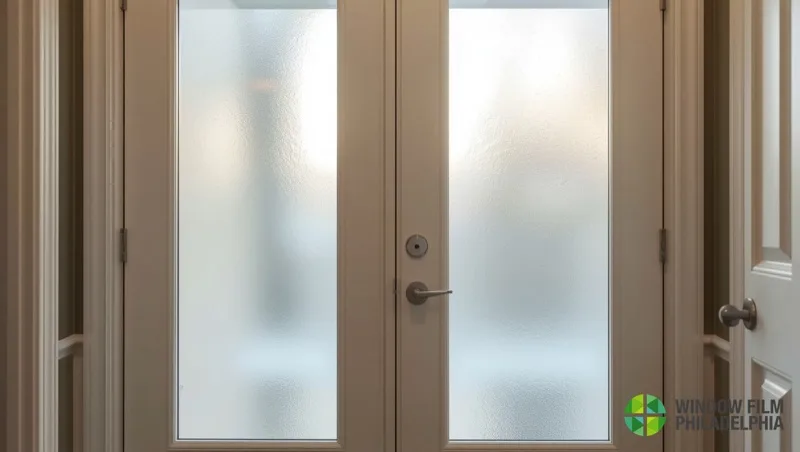
Frosted window film is not a single product — it is a category. The frosted appearance comes from either a dyed polyester layer, a vapor-deposited metallic coating, or a ceramic particle infusion that scatters visible light. What matters for heat reduction is what sits beneath that frosted surface. A purely decorative frosted film with no heat-rejecting layer might have a TSER of only 15–20%, blocking some visible light but letting most infrared pass straight through. A frosted ceramic film, on the other hand, can achieve a TSER of 50% or higher because the ceramic nanoparticles actively absorb and reflect infrared energy regardless of the visible light scattering.
When we install frosted film for heat reduction purposes, we look at products like 3M Fasara series — these decorative films combine a frosted or etched-glass aesthetic with varying degrees of solar performance. The 3M Fasara SH2MAG, for example, provides a frosted appearance while rejecting a meaningful portion of solar energy. LLumar also offers frosted privacy films with ceramic construction that push TSER above 45%. The point we always make to clients: frosted does not automatically mean heat-rejecting, but when you choose the right product, you get both privacy and thermal performance in a single application.
Frosted Glass vs. Clear Solar Control Film for Philadelphia’s Climate
This is one of the most common comparisons we walk through with clients. A clear or lightly tinted solar control film — such as 3M Prestige 70 or Vista Solar Control 5 — will typically outperform a frosted film on raw heat rejection. A spectrally selective clear film can hit TSER values of 55–60% while maintaining a VLT (visible light transmittance) of 50–70%, meaning the glass looks nearly clear but rejects substantial infrared. For a Center City office where views matter and natural light is a priority, clear solar control is usually the better choice.
Frosted film enters the conversation when privacy is a co-requirement. A South Philly bathroom window facing a neighbor’s house three feet away needs privacy. A ground-level conference room in a University City medical office needs privacy for patient confidentiality. In those scenarios, you cannot use a clear film — you need visual obscuration. The question becomes: can you get adequate heat rejection alongside that privacy? The answer is yes, with the right product. For situations where heat is the sole concern and privacy is not a factor, we typically recommend energy-saving window film rather than frosted options, because you get better thermal performance without sacrificing daylight.
Low-E Film for Four-Season Comfort in Philadelphia Buildings
Philadelphia is not only a cooling climate. We get hot, humid summer stretches, but we also get winter mornings where old glass feels cold to sit beside. When a room’s discomfort runs both directions — overheating in July, drafty and cold in January — neither frosted film nor standard solar film is the complete answer. Low-E (low-emissivity) window film is designed for exactly that four-season problem: it reduces solar heat gain in warmer weather and reflects a portion of interior heat back indoors during colder months.
For older rowhomes, churches, schools, and commercial buildings where full window replacement is not practical, Low-E film can be a serious retrofit option. It helps reduce radiant heat transfer through glass, supports comfort near windows, and preserves more natural light than heavy window coverings. When specified correctly, it can also help lower energy consumption year-round, although we never promise exact savings without a building-specific analysis. Federal efficiency incentives are usually tied to qualifying windows and skylights, so we point owners to ENERGY STAR’s windows and skylights tax credit page when they are comparing window upgrades and energy criteria. If a room needs privacy and four-season comfort, we often pair a frosted privacy band with a Low-E or solar-control film on the main exposed glass — the same layered approach we take whenever glass has more than one job to do.
Real-World Heat Reduction in Philadelphia Sun-Exposed Rooms
We installed frosted ceramic film in a Fairmount brownstone dining room with a large west-facing window last summer. Before the film, the room temperature would climb 8–10 degrees above the thermostat setpoint between 2 PM and 6 PM. The homeowner had resorted to keeping the blinds closed all afternoon, which defeated the purpose of having a window at all. After applying a frosted ceramic film with a TSER around 47%, the afternoon temperature swing dropped to 2–3 degrees. The room stayed comfortable with the blinds open, and the frosted finish provided privacy from the neighboring rowhome just six feet away.
Another project involved a Reading Terminal Market-area storefront where the owner wanted to display products without sun bleaching them, while also keeping the shop interior comfortable. We used a frosted film on the lower half of the glass for privacy and a clear solar control film on the upper half for views. This split approach is something we do frequently — it gives clients the best of both worlds. The frosted section rejects heat and blocks UV to protect displayed merchandise, while the clear upper section maintains natural light and street visibility. According to ENERGY STAR guidance for efficient windows, proper window treatments can significantly reduce cooling loads, and our field experience across hundreds of Philadelphia installations confirms this every summer.
Choosing the Right Frosted Film for Heat-Sensitive Philadelphia Spaces
Not all frosted films are created equal, and choosing the wrong one can leave you with a room that looks private but still overheats. Here is how we approach product selection:
3M Fasara SH2MAG. A silver frosted film with moderate heat rejection. We use this in offices and retail spaces where a clean, modern frosted look is desired alongside some thermal benefit. TSER is around 30%, making it a middle-ground option.
LLumar Ceramic Frost. A ceramic-based frosted film that pushes TSER above 45% while maintaining a consistent etched-glass appearance. This is our go-to for residential applications like bathrooms and bedrooms where both privacy and heat reduction matter.
Vista Versa Frost. A decorative frosted film with UV rejection above 99% but lower TSER (approximately 20%). We recommend this when fading protection is the priority and heat is a secondary concern.
Solyx SX-480. A gradient frost that transitions from clear to opaque. Useful for storefronts where you want privacy at eye level but clear views up top. Heat performance depends on the clear-to-frost ratio.
The selection process always starts with the client’s primary concern — is it privacy, heat, fading, or a combination? From there we match the product construction to the performance need. For clients focused specifically on reducing cooling costs, we often steer them toward energy-saving window film options that may include frosted products but are selected primarily for their TSER ratings.
The Installation Difference for Frosted Films in Historic Philadelphia Buildings
Philadelphia has a lot of historic building stock — Society Hill townhomes, Old City commercial spaces, Chestnut Hill Victorians — and these buildings present unique installation challenges. Many have original glass that is uneven, wavy, or slightly out of square. Frosted film actually hides some of these imperfections better than clear film because the light-scattering effect masks minor glass distortions. However, the installation technique must account for the age and condition of the glass.
What we never do is apply film to glass that shows signs of seal failure in insulated units or stress cracks. On single-pane historic glass, we check for putty integrity and surface condition before installation. The film application itself uses a wet method — we spray a slip solution on the glass and the film adhesive, position the film, then squeegee out the moisture. With frosted films, getting a perfect squeegee pass is critical because trapped moisture creates visible bubbles under the frosted surface that you would not see under clear film. Our installers take extra time on frosted applications to ensure every drop of solution is extracted. On older glass with deep surface irregularities, we may recommend a thicker mil frosted film that bridges minor imperfections without telegraphing them through the surface.
Frequently Asked Questions
Does frosted glass film block UV rays?
Yes. Nearly all quality frosted window films block 99% or more of ultraviolet radiation. The frosted layer itself scatters visible light, but the underlying film construction includes UV absorbers that prevent the most damaging wavelengths from passing through. This makes frosted film excellent for protecting artwork, furniture, and flooring near sun-exposed windows.
How much heat can frosted window film actually reduce?
It depends on the film construction. A basic decorative frosted film might reduce solar heat gain by 15–20%, while a ceramic-based frosted film can achieve TSER values of 45–55%. The difference is significant. We always show clients the spec sheet before installation so they understand exactly what performance level they are getting.
Will frosted film make my room too dark?
Frosted film reduces visible light transmittance — that is part of how it provides privacy. However, it does not make a room dark the way blackout curtains do. Frosted film scatters light rather than blocking it, so the room still receives diffused natural illumination. A frosted film with a VLT of 50% will cut visible light in half but distribute what remains evenly throughout the space.
Can I apply frosted film to double-pane windows?
In most cases, yes. The key factor is the film’s absorption rate. Films with high absorption can raise the glass temperature on double-pane units and potentially stress the seals. We select low-absorption frosted films for insulated glass units and always verify compatibility before installation. If a seal has already failed, we will not film that window — it needs glass replacement first.
How long does frosted window film last in a Philadelphia climate?
Quality frosted films from 3M, LLumar, and Vista carry warranties of 10–15 years. In our experience, they perform well for 12–20 years in Philadelphia’s climate. The freeze-thaw cycle and humidity do not significantly degrade modern film adhesives. What eventually causes failure is typically physical damage — scratches from cleaning, impact from objects, or improper maintenance.
Is frosted film difficult to remove if I want to change it later?
Professional removal is straightforward but should not be a DIY project. We use a steamer to soften the adhesive and a specialized scraping technique that preserves the glass surface. On historic glass, we take extra care to avoid scratching. Removal typically takes about half the time of the original installation.
Philadelphia summers are only getting hotter, and the buildings most affected — our historic rowhomes, glass-heavy commercial spaces, and sun-baked storefronts — are the ones where frosted film can do the most good. If you have a room that overheats every afternoon and privacy is also a concern, the right frosted ceramic film can address both problems in a single installation. Every building is different, and the best way to know what will work for yours is to get a free consultation with our installation team. We assess the glass, measure the solar exposure, and recommend the specific product that fits your space.