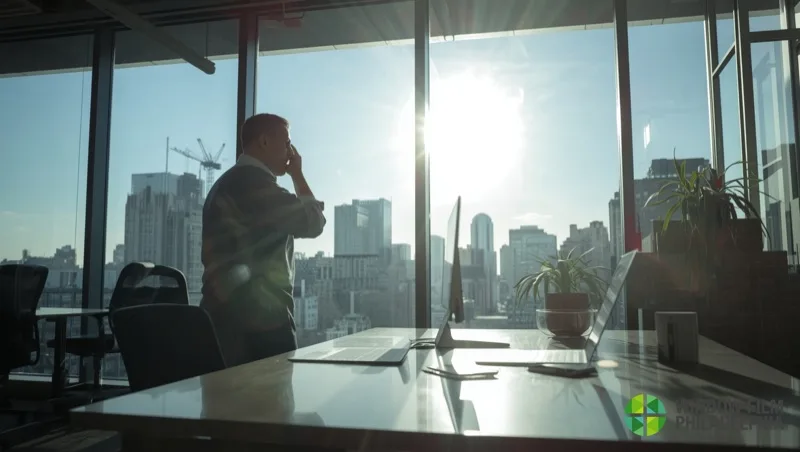
When the 3 PM sun turns a Center City conference room into a greenhouse, or a Fishtown row house owner replaces their third set of blinds in two years from sun damage, people start asking real questions. They don’t want marketing—they want to understand if ceramic window tint actually stops heat in Philadelphia or if it’s just fancy glare control that sounds smart. We’ve seen both outcomes in hundreds of installations, and the science confirms that when selected correctly, ceramic film is one of the most effective single upgrades for managing summer heat without sacrificing views.
We recommend ceramic tints specifically for these Philadelphia scenarios: west-facing urban spaces that overheat in summer, homes with southern exposure where furniture keeps falling, and any building where AC runs constantly despite insulated glass. What it delivers depends heavily on the product chosen, the glass condition, and professional installation—but across our clients from Old City to University City, the most effective films deliver heat rejection numbers that surprise even skeptical property managers.
Why does ceramic tint beat dyed films at heat rejection?
Conventional dyed window film works like a piece of tinted plastic: it absorbs visible light and a small amount of heat, turning solar energy directly into thermal radiation. The problem with this approach, especially on the thick glass found in older Philly homes, is that absorption makes the glass hotter and increases stress on the window seals. We’ve had to replace more than a few IGUs where DIY-installed dyed film created enough thermal imbalance to crack the edges.
Ceramic window film takes a completely different approach. Instead of just absorbing heat, it uses specially engineered nanoparticles—typically from non-conductive ceramic materials like titanium nitrate—to reflect and block infrared (IR) radiation before it converts into heat. These nanoparticles are embedded in a multilayer construction and sized to target the specific wavelengths of near-infrared light where over 50% of solar heat resides, while allowing visible light to pass through.
3M Crystalline Series. The gold standard in our experience. We use it on homes in South Philly and Center City where maximum heat rejection with high clarity is essential. It’s not the cheapest option, but its nano-ceramic particles deliver 60% total solar energy rejection on single-pane glass and 50% on dual-pane, blocking heat without making interiors dramatically darker. It also blocks 99% of UV rays—the real culprit behind fading.
Llumar Air Blue 50. Ideal for commercial installations where heat and glare are both major issues. It combines ceramic particles with a slightly bluer spectral signature to target not just heat but visible light intensity. We use this on offices in the financial district and on historic buildings in Rittenhouse where solar control can’t compromise the architectural integrity through obvious color shifts.
Solyx SP40. A solid middle-ground product we use in budget-conscious projects. While not as high-performing as 3M Crystalline, it still blocks around 43% solar heat on typical double-pane glass and performs consistently even when installed over older glazing systems. It’s our go-to for row houses in Manayunk and Overbrook where thermal performance matters but so does cost.
We don’t use films that claim ceramic benefits but rely mostly on metalized or dyed layers underneath. Those products might reduce glare and offer slight heat blocking, but they won’t deliver the IR rejection needed to lower interior temperatures in our humid Philadelphia summers.
How Much Heat Does Ceramic Tint Actually Block in Real Philly Installations?
Heat rejection isn’t a binary yes/no—it depends on glass type, sun angle, existing insulation, and film performance specs like TSER (Total Solar Energy Rejected) and SHGC (Solar Heat Gain Coefficient). In our work, we’ve seen indoor temperature reductions between 5°F to 18°F depending on conditions, with the greatest benefits in west-facing exposures that receive direct afternoon sun.
For single-pane vintage windows—common in pre-war buildings and older row homes—switching from uncoated glass to a quality ceramic film can reduce solar heat gain by up to 50%. That’s not just comfortable—it’s measurable on energy bills. We worked with a Center City law firm last summer that was averaging 28 kWh/day on AC for two conference rooms. After installing 3M Crystalline, their usage dropped to 18–20 kWh/day, with a corresponding indoor temperature drop of 8–10°F.
On dual-pane windows with a weak or missing low-e coating, ceramic tint provides similar benefits, though gains are slightly less dramatic. The Department of Energy has found that about 76% of sunlight that falls on standard double-pane windows enters as heat. Advanced ceramic films can reduce that transfer by reflecting infrared radiation before it penetrates the interior space.
Vista Films 70X. A newer ceramic-based film we’ve started using in mixed-use buildings. With a TSER of 58% and SHGC of 0.34, it reduces solar heat more effectively than older dyed films while maintaining 70% visible light transmittance. We installed it on a mixed-use building in University City and recorded an average 12°F interior drop on south-facing upper floors during July.
When we inspect a site, we use a heat meter to simulate solar exposure and provide a before-and-after reading. That way, the client sees the performance difference rather than just hearing claims. If the film doesn’t reduce surface temperature by at least 7°F under test lights, we don’t recommend it.
Ceramic vs. Other Film Types: What Works Best in Philadelphia’s Climate
Philadelphia’s hot, humid summers and moderate winters demand films that reduce heat in summer without creating winter heating penalties. Here’s how the compared to alternatives:
Standard Dyed Films. These use a polyester base coated with dyes to absorb visible light and some heat. In our experience, they reduce solar heat by 15–25%, which is minimal for homes with serious summer discomfort. Worse, dye-based films fade in sunlight—which is why you’ll see old purple-tinged windows all over Philadelphia. The absorbed heat stresses window seals, especially on double-glazed units, potentially voiding manufacturer warranties. We see this often in Old City brownstones where previous installers used dyed film to cut costs.
Metalized Films. These embed microscopic metallic particles to reflect both heat and radio frequencies. While they offer better heat rejection (30–45%), they also block Wi-Fi, cell signals, and GPS, which is unacceptable in offices, restaurants, and smart homes. We occasionally use them in industrial settings, but never in buildings relying on wireless connectivity.
Carbon-Based Films. Marketed as “carbon tint,” these films use carbon particles for a matte black appearance and moderate heat rejection (35–40%). They don’t interfere with signals like metalized films, but their dark color significantly reduces visible light, making interiors feel cave-like. We only recommend them for specific aesthetic reasons—rarely for heat performance alone.
Ceramic Films. Stand out because they reject 40–60% of solar heat without conducting electricity, interfering with signals, or discoloring over time. Their spectral selectivity—blocking infrared while passing visible light—makes them uniquely suited for Philadelphia’s climate. We’ve found they deliver consistent performance across seasons and require no adjustment from residents. The upfront cost is higher, but the longevity (typically 15+ years) and energy savings make it worthwhile.
Our rule is simple: if heat reduction is the client’s primary concern, ceramic is the only real choice. Other films serve different purposes but won’t solve the core issue of rising interior temperatures in a Philly heat wave.
Can Ceramic Window Film Replace AC or Windows?
We get asked this every summer: “Can I skip replacing these old windows if I add ceramic tint?” The honest answer is that ceramic film is a strong supplement—not a full substitute. It can significantly reduce cooling loads and delay window replacement, but it won’t fix air leaks, poor insulation, or failing seals on 30-year-old double-panes.
For a 1920s row house in Fishtown with intact—but uninsulated—windows, we’ve seen ceramic tint reduce heat gain enough to allow downsizing from a 3-ton AC to a 2.5-ton unit. That’s real mechanical relief and a step toward lower cooling costs. But when the glass is cracked, the seals are blown, or the frames are rotted, no amount of film will compensate.
We also don’t recommend ceramic film as a solution for homes with chronic condensation. Condensation between panes is a failure of the IGU seal, not a heat or sunlight problem. Adding film adds thermal stress to a system that’s already stressed. We saw a case in a South Philly home where film was installed over failed dual-panes—after one hot summer, the added heat triggered complete seal failure.
Our approach is always diagnostic: we inspect the glass and framing first. If it’s structurally sound but thermally inefficient, ceramic film is a smart upgrade. If it’s failing, replacement is the only lasting fix.
Installation Best Practices for Maximum Heat Rejection in Philadelphia
Even the best ceramic film fails when installed poorly. What separates a $10 DIY job from a professional installation isn’t just appearance—it’s long-term performance.
Prep is 80% of the outcome. We don’t just clean with rubbing alcohol. We clean, degrease, and decontaminate glass using a four-step process: first a wet squeegee to remove dust, then a solution of 90% water and 10% glass cleaner to lift oils, then a final de-ionized water rinse to prevent mineral spots, and finally a lint-free microfiber wipe. Skipping any step leaves residue that creates hazing, bubbles, or premature delamination.
Application temperature matters. We won’t install ceramic film below 55°F or above 90°F. Why? The adhesive layer behaves differently in extreme temperatures. In high heat, it activates too quickly and traps bubbles; in cold, it doesn’t bond properly. We schedule most residential installations for spring or early fall, avoiding the July–August temperature extremes when possible.
Edge sealing is critical. A perfect center and fuzzy or exposed edges are a sign of poor work. We use a silicone edge sealant on every installation to prevent moisture ingress and edge lift. This step alone doubles the film’s service life.
Signs You’re Getting a Poor-Quality Ceramic Window Film
Not all “ceramic” films are what they claim. The market is flooded with dyed or metalized films that say “ceramic technology” in the marketing but deliver far less heat rejection.
The Film Fades or Changes Color. True ceramic films are non-reactive and do not oxidize in sunlight. If a film turns purple, bronze, or hazy within two years, it’s not ceramic. We’ve used films from all major manufacturers and find that only those with certified nanoparticle layers maintain appearance consistently.
No TSER or SHGC Data. Reputable brands publish performance specs. If the manufacturer won’t provide Solar Heat Gain Coefficient or Total Solar Energy Rejected stats—walk away. We keep a master spreadsheet of all films we use with verified DOAS ratings.
It Interferes with Signals. Ceramic is non-conductive. If your cell or Wi-Fi signal drops after installation, you’ve got a metalized film, not ceramic.
We’ve had clients show up with film they bought online—usually from Amazon or eBay—claiming ceramic content. In every case we tested, the performance didn’t match the specs. That’s why we only use films from 3M, Llumar, Vista, and Solyx—brands we can verify through distributor channels.
Why West-Facing Windows in Center City Offices Overheat Every Afternoon
It’s not just about the sun—it’s about the building materials. Office buildings in Center City are often masonry high-rises with dark brick exteriors and deep window recesses. In summer, these materials absorb heat all day. By 2 PM, the west-facing façade is radiating stored heat inward, compounded by direct sunlight through large windows.
We see offices where the HVAC runs at full capacity but won’t maintain temperature because the heat load is coming from the structure itself, not just solar gain. In these cases, blocking 70% of solar energy with a ceramic film reduces the immediate light-to-heat conversion and gives the AC a fighting chance.
Case Study: 1601 Cherry Street. A 12-story office building with floor-to-ceiling glass. After installing 3M Crystalline on all west-facing units, tenants reported a 15°F average drop in afternoon office temperatures, and building management noted a 22% reduction in cooling energy use during peak months.
Why We Recommend Low-E Windows Even with Ceramic Film
Our stance is simple: ceramic film is one layer of protection, not the only one. For properties with the budget for both, we recommend dual investment. Low-E windows with ceramic film provide year-year efficiency—resisting heat gain in summer and minimizing heat loss in winter.
The same approach we take in our commercial window film installations applies to residential projects: layer the technologies. A historic home in Rittenhouse with restored low-E dual-pane windows and 3M Crystalline film is dramatically more efficient than one with either upgrade alone.
Frequently Asked Questions
Does ceramic window tint actually reduce heat?
Yes, ceramic window tint reduces heat by blocking up to 60% of incoming solar energy, depending on the product and glass type. Unlike dyed films that primarily absorb heat, ceramic tint uses nanoparticles to reflect infrared radiation—the portion of sunlight responsible for over 50% of solar heat gain—before it passes through the glass. We see this in real-world performance: interior temperatures in protected spaces average 8–12°F cooler than untreated rooms during peak summer in Philadelphia.
How much cooler does ceramic tint make a room?
On average, rooms with quality ceramic film installed see a temperature reduction of 5–18°F during peak summer sun, depending on window size, orientation, and building materials. The most dramatic effects are on west-facing spaces with large glass areas, like Center City offices receiving afternoon exposure. We regularly use thermal meters on-site to demonstrate before-and-after temperature differences before final installation.
Does ceramic tint block all heat from the sun?
No film blocks 100% of heat—doing so would require an opaque barrier. Even the best ceramic films reject 40–60% of total solar energy, not all heat. The remainder comes through as visible light and absorbed heat in the glass itself. However, this 40–60% reduction is enough to make interiors noticeably cooler, reduce AC runtime by 20–35%, and significantly improve comfort in humid conditions.
Is ceramic tint worth the extra cost in Philadelphia?
For most Pennsylvania property owners dealing with summer heat, ceramic tint delivers a positive return on investment. The higher upfront cost is offset by energy savings, reduced furnishings fading (up to 99% UV block), and longer film lifespan (15+ years). We calculate payback periods between 3–5 years on typical homes, depending on AC usage. Given Pennsylvania’s long cooling season, it’s one of the most effective single-passive upgrades for thermal comfort.
Will ceramic window film damage my windows?
When installed properly on structurally sound glass, ceramic film will not damage windows. However, if the insulated glazing unit (IGU) seals are already compromised or the glass is cracked, adding film increases thermal stress and may accelerate failure. We inspect all glass before installation and never apply film over failing units. Quality ceramic films also do not discolor or degrade over time—if you see a film turning purple or cloudy, it’s not true ceramic.
What Makes Window Film Installation Rewarding for Our Team
What keeps us coming back to this work is seeing the immediate difference it makes—someone walks into an office after installation and says, “I can finally open my eyes without squinting,” or a homeowner tells us their AC hasn’t kicked on all day despite 95-degree heat. That’s real comfort, achieved through craftsmanship and precision.
If you’re struggling with heat in your Philadelphia building, contact our team for a diagnostic assessment and demonstration of how ceramic tint can reduce your cooling burden. We’ll show you the difference with real data—no hype.