The Short Answer: UV Blocking Alone Does Not Reduce Much Heat
If you are asking does blocking UV rays reduce heat in your Philadelphia home or office, the honest answer is: not by much. Ultraviolet radiation accounts for only about 3% of the solar energy that reaches the Earths surface. The real heat drivers are infrared radiation (roughly 53%) and visible light (about 44%). So while a film that blocks 99% of UV will protect your skin and furnishings from fading, it will only chip away at a small slice of the total heat load streaming through your windows.
The question does blocking UV rays reduce heat comes up often because people assume UV and heat are the same thing. They are not. Most quality window films block UV and reject significant amounts of infrared heat, and that combination is what actually lowers room temperatures and cooling costs. Understanding the difference between UV protection and total solar energy rejection helps Philadelphia property owners pick the right film instead of expecting UV-only protection to solve a heat problem.
How Solar Energy Breaks Down at the Glass
Sunlight carries three distinct energy bands, and each contributes differently to the heat you feel near a window:
- Ultraviolet (UV): Roughly 3% of solar energy. Causes fading, skin damage, and material degradation. Nearly all quality window films block 99% or more.
- Visible light: About 44% of solar energy. This is the light you see. Tinted and ceramic films reduce visible light transmission to cut glare and some heat.
- Infrared (IR): Approximately 53% of solar energy. This is the heat you feel. High-performance films with IR rejection technology target this band directly.
When someone asks does blocking UV rays reduce heat, the follow-up question should always be: what about infrared? A film that only blocks UV is like wearing sunscreen indoors; it protects you from damage but does not cool the room. The EPA sun safety resources explain how UV radiation affects human health, but heat reduction requires a broader approach.
What UV Window Film Actually Does for Philadelphia Buildings
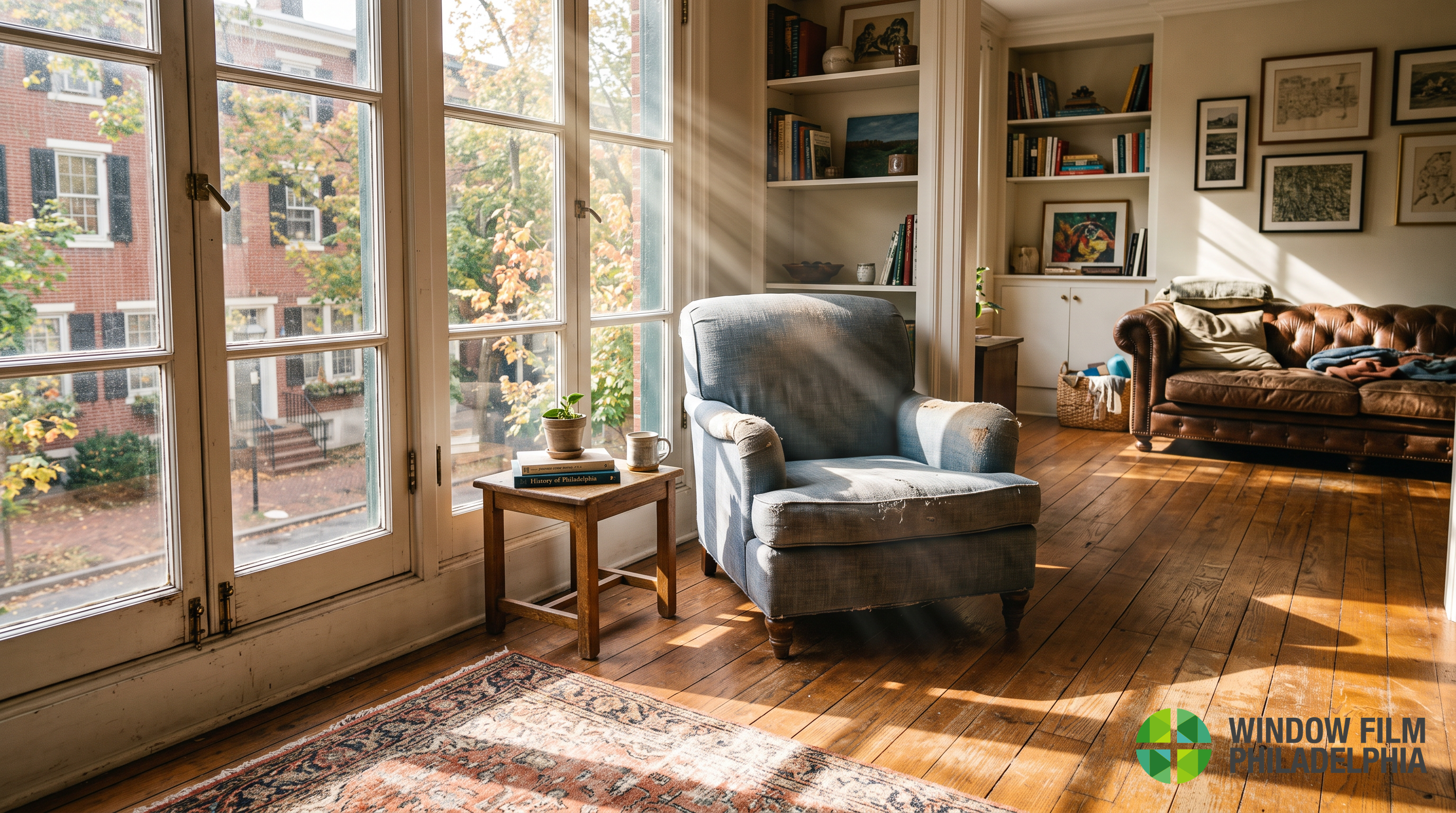
UV window film is excellent at what it is designed to do: stop ultraviolet radiation from entering your space. The UV blocking window film we install in Philadelphia blocks up to 99.9% of UV rays, which dramatically reduces fading of hardwood floors, artwork, upholstery, and retail merchandise. In neighborhoods like Old City and Fishtown, where historic homes often feature large south-facing windows, that UV protection preserves irreplaceable interior details.
But if your primary complaint is hot rooms and high cooling bills, UV blocking alone will not move the needle. You need a film with strong Total Solar Energy Rejected (TSER) ratings. TSER measures the percentage of total solar energy (UV, visible light, and infrared combined) that a film keeps out. A higher TSER means more heat reduction across the full solar spectrum. So does blocking UV rays reduce heat on its own? Only marginally. But a film with high TSER that also blocks UV delivers real, noticeable cooling.
Real-World Heat Reduction: 3M and Llumar Performance Data
To put numbers behind this, here is what leading films deliver when they block UV and reject infrared heat:
- 3M Prestige Series (PR40): Blocks 99.9% of UV, rejects up to 97% of infrared heat, and achieves a TSER of up to 60%. This means nearly two-thirds of total solar energy never enters the room.
- 3M Sun Control Window Film (Night Vision 15): Blocks 99% UV, rejects up to 72% of glare, and delivers a TSER around 63% with strong heat reduction and a darker daytime appearance.
- Llumar Solar Control Film (DRN35): Blocks 99% UV with a TSER of approximately 54%, reducing heat while maintaining a natural visible light level.
Compare those numbers to a UV-only film that might block 99% of UV but has a TSER of only 5 to 8%. The difference is night and day. A film with 60% TSER can lower room temperatures by 5 to 9 degrees Fahrenheit on a hot Philadelphia July afternoon, while a UV-only film might reduce temperature by less than a single degree. This is why answering does blocking UV rays reduce heat requires looking at the full film specification, not just the UV rejection number.
Philadelphia Climate Makes IR Rejection Essential
Philadelphia sits in a humid subtropical climate zone where summers bring relentless heat and humidity. From June through August, afternoon temperatures regularly climb past 90 degrees, and the urban heat island effect makes Center City and University City even hotter than surrounding suburbs. Rowhomes in South Philly and Manayunk often have windows on opposite walls, creating a greenhouse effect where solar heat pours in from both sides.
In this environment, energy savings from window film come primarily from IR rejection, not UV blocking. A high-TSER film reduces the load on your air conditioning system, which translates to lower utility bills and more consistent indoor comfort. The Pennsylvania energy code recognizes window film as an approved energy conservation measure, and many Philadelphia commercial buildings use it to meet thermal performance targets without replacing existing glazing.
When UV Protection Matters Most
Even though the answer to does blocking UV rays reduce heat is not much, UV blocking remains critical for other reasons:
- Fading prevention: UV is the leading cause of fading in fabrics, wood, photographs, and painted surfaces. Blocking 99% of UV can extend the life of your interior by years.
- Skin health: The Skin Cancer Foundation notes that chronic UV exposure through windows contributes to skin damage, particularly for people who work near glass all day.
- Retail protection: Philadelphia boutiques and shops along Walnut Street and Germantown Avenue rely on UV film to prevent merchandise from fading on display racks.
For offices and commercial spaces where glare reduction also matters, combining a UV-blocking layer with an IR-rejecting tinted or ceramic film delivers the best of both worlds: cooler rooms, less screen glare, and full fade protection.
Choosing the Right Film for Heat Reduction in Philadelphia
If heat is your main concern, look for films with these specifications:
- TSER of 50% or higher tells you the film rejects at least half of all incoming solar energy, including UV, visible light, and infrared.
- IR rejection of 80% or higher specifically targets the infrared band where most heat lives.
- 99% UV blocking is standard across quality films, so this should be a given, not a selling point on its own.
- Visible light transmission (VLT) that fits your space means lower VLT for darker film and more heat reduction, or higher VLT to preserve natural light.
A professional installer can test your windows and recommend the right balance. For Philadelphia mixed climate with hot summers and cold winters, products like 3M Thinsulate Window Film add low-emissivity insulation that also helps retain heat in winter, making them a strong year-round choice.
Ready to Cut the Heat?
If your Philadelphia home or business runs hot in the summer, UV blocking alone will not solve it, but a properly specified solar control window film will. At Window Film Philadelphia, we assess your glass, sun exposure, and comfort goals to recommend the film that delivers real, measurable heat reduction, not just UV numbers on a spec sheet.
Contact us to schedule a consultation and find out exactly how much heat we can keep out of your building.