Why do homeowners mix up UV and heat?
Most people asking does blocking uv rays reduce heat in a Philadelphia home are really asking two questions at once. The first is whether the UV protection built into a window film will, by itself, make a room cooler. The second is whether a film that markets itself around UV blocking is doing what they think it is doing during the long, sun-heavy hours of a Philadelphia summer.
The short answer matters more than the marketing copy. UV makes up only a small slice of the energy coming through untreated glass. Solar heat gain comes from the much larger infrared and visible-light portions of the sun’s spectrum. So a film that blocks UV well will protect skin, hardwood, fabrics, and artwork, but it will not, by itself, solve a hot room. The films that actually cool a room are the ones designed to reject infrared and visible light, often alongside the UV protection.
This is worth understanding before any installation in rowhomes, condos, or detached houses around Philadelphia, because the wrong expectation leads to the wrong product. UV protection is real, and it is valuable. Heat reduction is also real, but it requires a different film technology.
What UV Actually Is and Why It Matters Indoors
UV is short-wavelength radiation that the EPA’s Sun Safety guidance groups into UVA and UVB bands. UVB causes sunburn on skin, while UVA penetrates deeper and contributes to long-term skin aging. Both also fade fabrics, photographs, wood floors, and artwork over months and years. Standard double-pane glass already filters out a meaningful share of UVB, but most of the UVA passes through, which is why interiors near sunny windows still fade.
That is why UV-protective window film exists. A clear film that blocks 99% of UV does not change how a room looks, but it removes most of the fading and skin-aging energy that is currently passing through the glass. For Philadelphia homes with original hardwood floors, oriental rugs, leather furniture, or wood trim, that protection alone is often worth the install.
But fading and skin safety are not the same problem as thermal comfort. UV is roughly 3% of the sun’s total energy at the surface, depending on conditions. The other 97% is visible light, infrared, and a small amount of other wavelengths. If a room is hot, the heat is arriving in those other wavelengths, not in the UV.
Where the Heat in a Philadelphia Room Actually Comes From
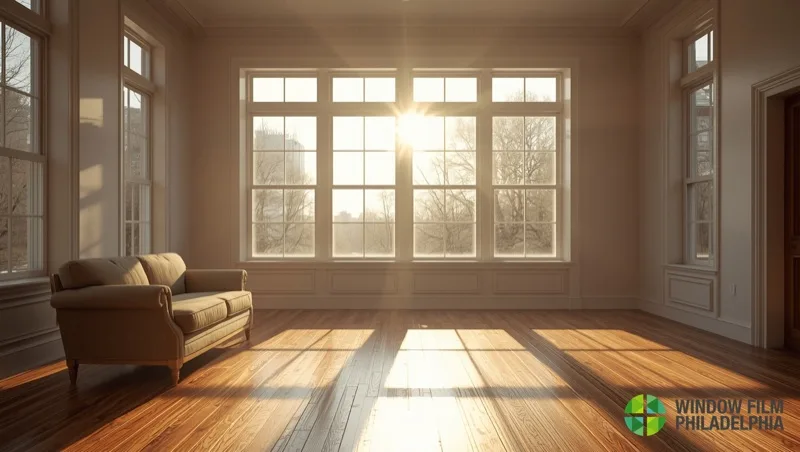
Solar heat gain through windows is dominated by visible light and near-infrared radiation. That energy enters the room, hits floors, walls, furniture, and bodies, and is re-radiated as heat. In Philadelphia, the strongest contribution tends to come from a few specific exposures.
- West-facing rooms in rowhomes from South Philly to Manayunk take a long, low, intense blast of afternoon sun that drives peak indoor temperatures between roughly 3 and 7 PM in July.
- South-facing bay windows and tall parlor windows in Center City and University City get lower-angle winter sun but strong shoulder-season heat from spring through early fall.
- East-facing bedrooms get cooler mornings but the load is short, so they are usually less of a thermal problem.
- Roof-level skylights and top-floor condo glass in newer towers take direct sun all day with little exterior shade.
In each case, the heat you feel is not coming from UV. It is coming from the much larger visible and infrared component of sunlight. That is why a film engineered only to block UV will leave the room just as warm as before.
What Films Designed for UV Protection Typically Deliver
Films sold primarily for UV protection are usually clear or very lightly tinted and engineered around a few simple goals: high UV rejection, low visible-light change, and minimal reflectivity. That combination works well in historic homes near Old City, in conservation districts, or anywhere the owner wants to keep the original look of the glass.
The performance numbers on these films are real. Most clear UV films reject 99% or more of UV radiation. That protects interior finishes and reduces UV exposure for people sitting near windows. Some of these films also offer a small amount of infrared rejection, often in the 20% to 40% range, which will slightly cool a room but will not transform comfort on its own.
The honest framing is that UV-focused film is a protection product more than a cooling product. If the goal is to preserve wood floors, art, and upholstery from Philadelphia’s bright summer exposure, it is a strong, low-visibility choice. If the goal is to lower the thermostat setting or stop closing the blinds every afternoon, the film needs to do more.
What Films Designed to Reduce Heat Actually Do
Films that are sold for heat reduction are engineered around solar control. They target the visible-light and near-infrared portion of the solar spectrum, which is where almost all unwanted heat lives. There are three main families.
Dyed films absorb solar energy and re-radiate some of it outward. They are an older technology, often used for automotive applications, and tend to fade over years in Philadelphia’s strong summer sun.
Metallized films reflect a meaningful share of visible and infrared light. They can deliver strong heat reduction, but they also create a more reflective exterior look that does not always suit historic Philadelphia facades, and they can interfere with cell and Wi-Fi signals in some buildings.
Ceramic and nano-ceramic films reject a large share of infrared and visible light while staying mostly clear and non-reflective. They are the option most Philadelphia homeowners end up choosing when both comfort and appearance matter. Many ceramic films also block 99% of UV, so a quality ceramic film can serve UV protection and heat reduction at the same time.
Why Ceramic Films Solve Both Questions
A well-specified ceramic window film is the most direct answer to the combined question of whether blocking UV rays also reduces heat in a Philadelphia home. The reason is that ceramic construction is one of the few technologies that can deliver high infrared rejection, visible-light control, and 99% UV rejection in the same layer without giving the glass a mirror-like finish.
That combination matters in Philadelphia for two reasons. First, the city’s housing stock ranges from 19th-century brick rowhomes with original wood windows to contemporary condos with floor-to-ceiling glass, and a film that performs well optically across both looks right at home. Second, the humid summers and shoulder-season sun mean many rooms get both skin-damaging UV and serious solar heat gain at the same time. A single ceramic installation can address both.
If a homeowner is choosing between two films that both claim UV protection, the one with documented infrared rejection, such as the higher-end 3M Prestige, Llumar Vista, or comparable ceramic series, will be the one that actually changes how the room feels in August.
Practical Choices for Philadelphia Homes
Picking the right film starts with identifying which problem is actually showing up in the room. UV protection and heat reduction show up as very different daily symptoms, and they tend to show up in different exposures.
- Fading floors, rugs, and upholstery on a south or west exposure usually points to a UV-dominant problem and is well served by a clear UV film or a ceramic film that adds UV rejection to broader solar control.
- Hot rooms in late afternoon on west exposures are heat-dominant. They want a film with strong infrared rejection, ideally ceramic, sized to the glass area.
- Glare on screens and TVs in home offices often comes from visible light. A film with moderate visible-light tint plus high UV and infrared rejection will usually solve that and the heat together.
- Historic facade preservation, or a desire to keep glass looking nearly original, often pushes the choice toward clear or lightly tinted ceramic films rather than darker or reflective films.
In rowhomes from Fishtown to Point Breeze, the most common successful combination is a mid-toned ceramic film on the front windows where street-facing heat and UV both arrive, paired with a clear UV-only film on less exposed elevations. That pairing delivers meaningful comfort gains on the front of the house and protects interior finishes throughout.
A Short Way to Read Any Window Film Spec Sheet
Most film spec sheets list UV rejection, visible-light transmission, and total solar energy rejected, often as TSER. That third number is the one to watch if heat is the concern.
A film that lists 99% UV rejection but a TSER in the 20s is doing its primary job on UV and only modest work on heat. A film that lists 99% UV rejection and a TSER in the 50s or 60s is doing both jobs. The higher TSER numbers usually come from ceramic or multilayer constructions rather than from clear UV-only films.
When comparing two films at the same UV rejection level, TSER is the clearest single proxy for how much cooler the room will feel after installation. Glare-sensitive homeowners should also look at visible-light transmission, since darker films reduce more heat but also change the room’s daylight.
Where UV Film Alone Is the Right Answer
There are Philadelphia rooms where UV protection is the only real concern, and where heat is already handled in some other way. A north-facing home office where the existing glazing already manages heat gain is a good candidate for a clear UV-only film that protects occupants during longer workdays near the window. So is a second-floor hallway or stair landing with original stained or leaded glass that the owner wants to preserve.
In those cases, adding a UV-only film is a targeted, low-visibility upgrade. It is not a heat-reduction project, and it should not be sold as one. Treating it as a heat project would lead to a film choice that does not match the actual goal.
How to Plan a Philadelphia Install That Gets Both
For most Philadelphia homes that ask this question, the right plan treats UV protection and heat reduction as related but separate goals, then chooses a film that meets both at once. A short planning pass makes the install smoother.
- Walk the home at midday and again in late afternoon to see which exposures are driving the discomfort.
- Note the symptoms: fading, glare, hot rooms, or all three.
- Pick a film family. Ceramic is usually the strongest answer for heat plus UV without a reflective look.
- Match visible-light transmission to the room. Living rooms and kitchens usually want more daylight than home theaters or south-facing bedrooms.
- Confirm the film will not violate any historic-district guidelines if the home is in a designated district near Old City, Independence Hall, or similar areas.
That sequence leads to a film that the homeowner can describe accurately to a partner, a renter, or a future buyer: a product that blocks 99% of UV, rejects enough infrared to make the room noticeably cooler, and keeps the building’s exterior appearance intact.
Talk With a Philadelphia Installer About the Right Film
If the goal is UV protection, heat reduction, or both, the next step is a quick site assessment that maps the symptoms to the right film. Across South Philly, Fishtown, Center City, University City, and the surrounding neighborhoods, the same question usually has a slightly different right answer depending on the exposure, the glass, and the historic context of the building.
For a local quote and a recommendation matched to the specific windows in your home, contact our Philadelphia window film team. We can help you choose a film that protects interiors, lowers room temperature, and fits the way your home actually faces the sun.