Why One-Way Film Fails After Sundown
Walk through any Philadelphia rowhome neighborhood after dark — Fishtown, South Philly, Graduate Hospital — and you can see straight into living rooms where lights are on and blinds are open. That is the core problem with reflective one-way window film: it depends on a brightness difference between the inside and outside. During the day, sunlight on the exterior glass creates a mirror effect that blocks outside views in. At night, when your interior lights are brighter than the street, the effect flips. People outside can see in, and you see your own reflection instead of the street.
This is not a flaw in the product — it is basic optics. Light always travels from the brighter side to the darker side. If you are searching for the best window film for nighttime privacy in Philadelphia, you need a solution that does not rely on that brightness differential at all. The right film blocks visibility regardless of which side has more light.
If you want to understand the mechanics of one-way film in more detail, our guide to one-way privacy film limitations breaks down exactly when the mirror effect holds and when it collapses.
Films That Deliver Privacy Around the Clock
The films that actually work after dark fall into a different category entirely. Instead of reflecting light, they obscure the glass surface itself — so the view is blocked from both sides, day or night, whether the lights are on or off.
Frosted and Matte Films
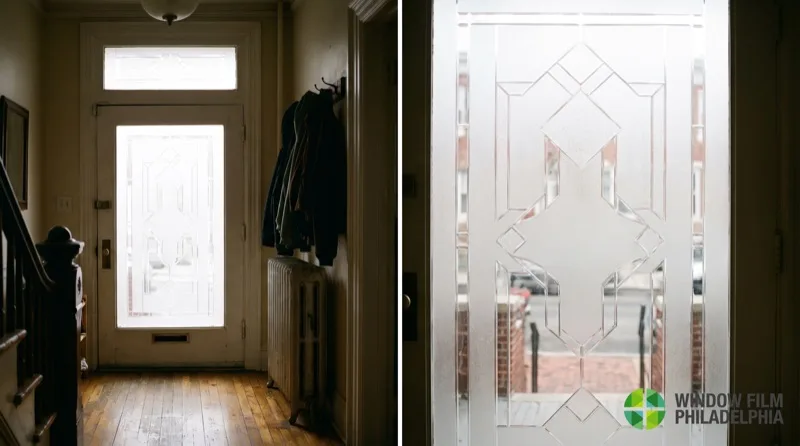
Frosted window film is the most reliable option for nighttime privacy. These films scatter light passing through the glass, making it impossible to discern shapes or details on the other side. They still transmit a significant amount of natural daylight, so rooms do not feel like caves.
3M Fasara Glass Finishes come in over 100 designs — from simple matte frost to patterns inspired by traditional Japanese washi paper and textile weaves. Each design lets you tailor the opacity level to the space. A bathroom window in a Society Hill townhouse might use a full frost for maximum privacy, while a Center City office conference room might use a gradient or pattern that obscures content while preserving an open feel. 3M Fasara films also block up to 99% of UV rays, which helps reduce fading on interior furnishings.
LLumar takes a similar approach with its iLLusions decorative film line. The Matte Frost Series provides a clean, uniform frosted appearance, while the Color Frost and Textured Frost collections add subtle color and dimension. These decorative window film options give you precise control over how much light passes through and how much visibility is blocked.
Blackout Films
When total privacy is the priority and natural light is secondary, blackout window film is the answer. These films block nearly 100% of visible light from passing through the glass. They are ideal for bedrooms facing busy streets — a South Broad Street apartment or a Manayunk unit overlooking Main Street — where you want complete darkness and zero visibility at night. The trade-off is that you lose your daytime view as well, so blackout film is best suited for spaces where that sacrifice makes sense.
Dual-Reflective Films
Dual-reflective films offer a middle ground. They have a more reflective exterior surface and a less reflective interior surface, which means they perform better than standard one-way film in the evening. However, they still rely on a brightness differential to some degree, so they are not a complete nighttime privacy solution on their own. They work well in living rooms and common areas where you might pair them with curtains or blinds for after-dark coverage.
Matching the Film to the Room
Every room in a Philadelphia home has different privacy needs. The right film depends on what is behind the glass, who might see through it, and how much natural light you want to preserve.
Here is a quick breakdown by space:
- Bedrooms — Blackout film or a heavy frosted film. Street-facing bedrooms in dense neighborhoods like Passyunk or Bella Vista benefit from blackout film if sleep quality is the priority. Frosted film works if you prefer to keep some daylight filtering in.
- Bathrooms — Frosted or matte film. These spaces need privacy at all hours, and frosted film lets you keep the window uncovered without exposing the room. LLumar’s Matte Frost Series is a strong fit here because it provides uniform opacity without darkening the space.
- Living Rooms — Dual-reflective film paired with window treatments. Use the film for daytime glare reduction and daytime privacy, then close curtains or blinds at night. This combo gives you the best of both worlds.
- Entryways and Sidelights — Frosted film on sidelight windows flanking a front door is one of the most common applications in Philadelphia’s trinity-style homes, where the front door opens directly onto the living area.
For a broader look at how privacy window film works across different building types and orientations, our benefits page covers the full range of options.
What to Avoid When Nighttime Privacy Is the Goal
Not every film sold as privacy film actually delivers after dark. Here are the common pitfalls:
- Standard reflective one-way film — Effective during the day, but reverses at night when interior lights are on. If a product is marketed purely as mirror film or one-way film without mentioning nighttime performance, assume it will not solve your after-dark privacy problem.
- Very light tint films — A light ceramic tint that reduces heat and glare will not meaningfully obscure the view from outside, day or night. These are energy films, not privacy films.
- DIY frosting sprays — Spray-on frost products create an uneven appearance, are difficult to remove, and do not provide the UV protection or durability of a professionally installed film.
The Philadelphia Context
Philadelphia’s housing stock creates specific privacy challenges. Trinity homes in South Philly have windows directly facing neighboring properties, sometimes just a few feet away. Center City high-rises have floor-to-ceiling glass that becomes a fishbowl at night. Old City loft conversions often have large industrial windows that were never designed with residential privacy in mind.
In each case, the solution is the same: choose a film that obscures visibility through the glass itself rather than relying on reflective optics. The LLumar decorative film collection includes matte, textured, and patterned options that deliver consistent privacy without sacrificing all natural light — an important consideration in narrow Philadelphia rowhomes where every lumen counts.
Professional installation matters too. A poorly applied film with bubbles, creases, or edge lifting looks worse than no film at all and can compromise the privacy effect. Films like 3M Fasara and LLumar iLLusions are designed for professional application to achieve a clean, uniform finish.
Get the Right Film for Your Space
Nighttime privacy is not a one-size-fits-all problem. The best window film for nighttime privacy in Philadelphia depends on which rooms you are treating, how much natural light you want to keep, and whether you need privacy around the clock or just after sundown. A professional assessment can help you match the right product to each window in your home or building.
Ready to stop worrying about who can see in after dark? Contact us to schedule a consultation and find the right nighttime privacy film for your Philadelphia property.